From the outside, Water Ka Doctor looks like a simple green-and-white cylinder. Inside, it holds a small piece of advanced materials science: thousands of hair-thin hollow fibres, each one an anti-microbial filter. This article explains — without jargon — how hollow-fibre ultrafiltration works, what makes PAKVITAE’s ERM membrane different, and why that difference matters for families who need safe water every day.
What is a hollow-fibre membrane?
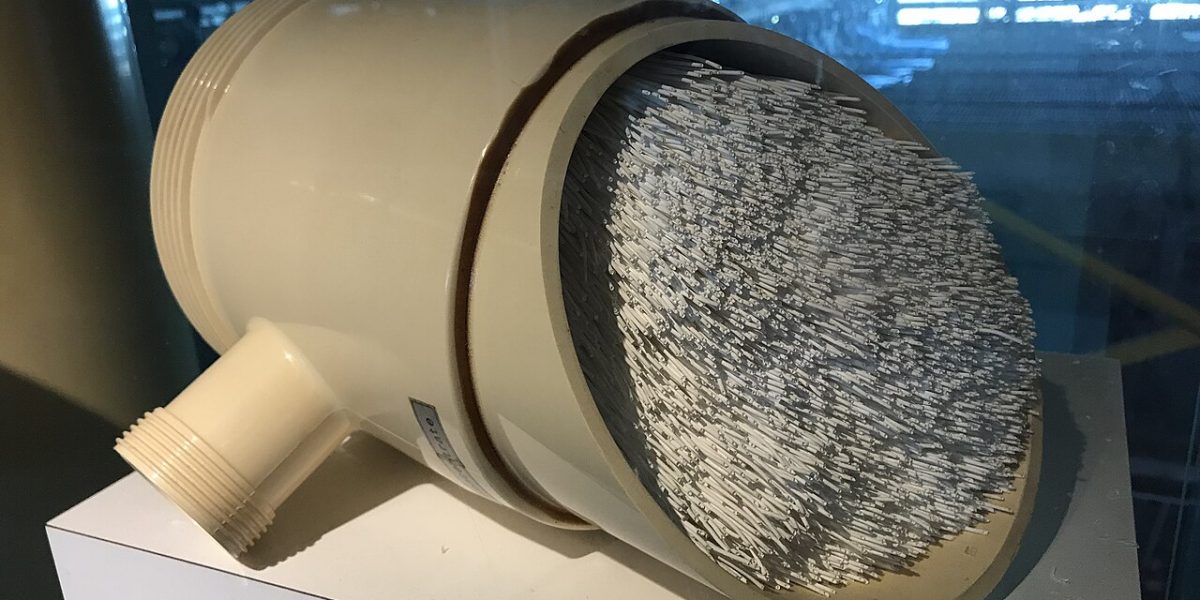
Imagine a drinking straw so thin it is barely wider than a human hair, with walls made of a porous plastic sponge. Now imagine thousands of these straws bundled together inside a tube. That is a hollow-fibre membrane module.
Contaminated water surrounds the outside of the fibres (or, in some designs, flows down their centre). Pressure pushes water through the porous walls. Water molecules and dissolved minerals pass easily, but anything larger than the pores — bacteria, parasite cysts, silt, rust and plastic particles — stays behind. The clean water collects in the hollow core of every fibre and flows out of the purifier.
Hollow-fibre membranes are the same type of technology used in large municipal water treatment plants, dialysis machines and industrial filtration. What PAKVITAE did was engineer it into a compact, affordable unit for homes, schools and emergencies.
Why 0.1 micron is the magic number
Water Ka Doctor is certified to 0.1 micron. That number matters because of the size of what you are trying to remove:
| Contaminant | Approximate size | Passes a 0.1-micron membrane? |
|---|---|---|
| Human hair (for comparison) | ~70 microns | — |
| Fine sand and silt | 2–60 microns | No |
| Giardia cysts | ~8–12 microns | No |
| Cryptosporidium oocysts | ~4–6 microns | No |
| E. coli and most bacteria | ~0.5–5 microns | No |
| Micro-plastic fragments | Down to sub-micron sizes | No (particles above 0.1 micron) |
| Dissolved salts and minerals | Molecular (nanometre) scale | Yes — minerals are retained in your water |
Because the barrier is physical, it does not depend on chemicals, contact time or electricity. If a bacterium is bigger than the pore, it simply cannot get through. That is how the membrane achieves its rated removal of 99.9999% of bacteria — a “6-log” reduction, meaning only one in a million would pass even in a heavily contaminated challenge test.
The hidden problem with ordinary membranes: bio-fouling
All filters trap germs. The question is what happens to those germs next. On an ordinary membrane, trapped bacteria do not just sit there — they feed on organic matter in the water, multiply and secrete a sticky layer called biofilm. This process, known as bio-fouling, causes three problems:
- Flow slows down. The biofilm clogs pores, so you get less water for the same pressure.
- Hygiene suffers. A living colony on the “dirty” side of the membrane is a reservoir of germs, particularly when the filter sits unused for days.
- Membrane life shortens. Aggressive cleaning or early replacement becomes necessary.
Many manufacturers try to solve this by coating membranes with an anti-microbial chemical. The coating works at first, but it is designed to break away from the surface and leach into the water to reach the microbes. Over time — sometimes within days of heavy use — the coating is gone, leaving behind open, weakened pores and a membrane that is no longer protected.
How ERM technology solves it
ERM — Esoteric Resistive Membrane — takes a different approach. Instead of coating the fibres, the anti-microbial agent, zinc, is built into the membrane material itself. The membrane is intrinsically anti-microbial.
Here is what happens when contaminated water meets an ERM fibre:
- Water and dissolved minerals pass through the 0.1-micron pores.
- Bacteria, cysts and particles are stopped at the surface.
- Microbes in contact with the zinc-bearing surface are killed.
- Dead microbes cannot multiply or form biofilm, so they remain loose on the surface.
- The next backwash flushes them away, restoring the membrane to near-original performance.
Because nothing needs to break off the surface to work, the anti-microbial effect lasts for the membrane’s working life instead of fading after the first weeks. The result is a filter that stays cleaner, flows faster for longer and is effective for extended periods at very low cost — which is how an $18 purifier can serve a family of five for two years or 10,000 litres.
A guided tour of the cartridge
If you could cut a Water Ka Doctor in half, this is the journey a drop of water would take:
- Inlet. Water enters from your tap adaptor or tubing. No pre-treatment, chemicals or electricity are added.
- The fibre bundle. Water spreads around thousands of hollow fibres packed lengthwise inside the housing. Because the fibres are so numerous, the water meets an enormous filtering surface in a very small space.
- The membrane wall. Pushed by tap pressure or gravity, water crosses the porous wall of each fibre. Here the 0.1-micron pores hold back bacteria, cysts, silt and plastics, while the zinc built into the membrane material acts on microbes touching the surface.
- The fibre core. Filtered water collects in the hollow centre of each fibre and flows towards the potted end of the bundle, where the fibres are sealed into a resin block.
- Outlet. Clean water leaves the purifier ready to drink immediately — there is no storage tank in which it could be recontaminated.
When you backwash, this journey runs in reverse: clean water is pushed from the core outwards, lifting trapped material off the outer surface so it can be flushed away.
Durability: why the fibres last two years
A membrane’s life depends on three things: how quickly it clogs, how well it resists microbial attack and how strong the fibres are. ERM addresses all three. Regular backwashing prevents permanent clogging; intrinsic anti-microbial action prevents biofilm from taking hold; and the fibres are engineered for strength, so they withstand daily pressure changes and repeated backwashing. Together, these allow a rated life of two years or 10,000 litres for a typical family of five — far longer than basic candle or cartridge filters, which often need replacing every few months.
The self-renewing backwash
ERM membranes are designed to be backwashed. Using the syringe supplied with every Water Ka Doctor, you push clean water backwards through the fibres. That reverse flow lifts trapped silt and dead microbes off the membrane surface and flushes them out of the purifier. In practical terms, every backwash renews your membrane, and it takes less than a minute. Step-by-step instructions are in How to Backwash and Maintain Your Water Filter.
Why it works without electricity
A single hollow fibre filters only a trickle. Thousands of fibres together create a very large filtration surface packed into a small cartridge. That large area means water does not need high pressure to pass through — the pressure from an ordinary household tap, an overhead tank or even a bucket raised above the purifier is enough. Water Ka Doctor delivers up to 60 litres per hour this way.
For Pakistan this is not a minor detail. Load-shedding, low-voltage supply and rural areas with no grid connection make electric purifiers unreliable exactly where safe water matters most. In the Afghan refugee settlement in Islamabad where PAKVITAE worked, around 90% of households lacked reliable electricity — portable, off-grid filters were the only practical solution. Read the full story on our Afghan Refugee Camp project page.
What ERM does not do — honestly
Good technology comes with clear limits, and we would rather you know them before you buy:
- It does not reduce TDS or salinity. Salty or brackish water needs reverse osmosis.
- It does not remove dissolved chemicals such as arsenic, fluoride, nitrate or pesticides. If you suspect these, get a water quality test.
- Viruses are much smaller than bacteria. During a declared hepatitis or other viral outbreak, follow health-department advice to boil or chlorinate water as an extra step.
- It has a rated life. Replace the purifier after two years or 10,000 litres, whichever comes first.
Tested in the lab and in the field
ERM technology has been tested and certified by NUST, SGS and the Pakistan Council of Research in Water Resources (PCRWR) — details on our certifications page. It has also been proven in some of the toughest conditions imaginable: in the 2018 Kerala mega-flood, where 50 PAKVITAE filters helped provide clean water to more than 5,000 people; in a Faisalabad village of around 1,000 residents; and in two Haroonabad primary schools with more than 500 students. The local NGO team in Kerala had both the source water and the filtered water tested in several laboratories and reported that the filtered water was of very good drinking quality, even from highly contaminated sources.
From one kitchen to a whole village
The same ERM fibres that serve a family also scale up. Because the membrane needs no power, community filters can be placed in a school corridor, a mosque courtyard or a village home and shared by many people. A single community filter can provide enough drinking water for around ten people a day, and several units together can serve an entire school. For relief agencies, portable units can be distributed straight from a truck and used the same day. Explore the Community Filter Station and our field projects.
The practical takeaway
Hollow-fibre ultrafiltration is a proven, physical way to remove bacteria, parasites, mud and plastics from water without electricity. ERM makes it better by building the anti-microbial protection into the membrane itself, so the filter resists bio-fouling, renews itself with a quick backwash and keeps working for two years. If your water is sweet but you cannot trust where it has been, this is the technology designed for you.
Put ERM technology to work in your home
Water Ka Doctor: 0.1-micron anti-microbial hollow fibres, 60 litres per hour, no electricity, two-year life. $18 with free delivery.
Shop Water Ka Doctor